
Contents (13)
- First, the number nobody puts on the homepage
- 1. You risk too much on every trade
- 2. You take profits early and let losses run
- 3. You trade far more often than you think
- 4. You decide where to get out only after you are in
- 5. You trade bigger straight after a loss
- 6. You keep no record, so you repeat the same mistake
- The mistakes that happen before the first trade
- How to find out which one is yours
- The nine months I blamed the wrong thing
- The one change that moves the number most
- Common questions
- The short version
If you keep losing money, the cause is usually not your analysis. It is the size of your positions, how often you trade, and what you do in the ten minutes after a loss. Those three things decide most of the result before the chart matters at all.
That is uncomfortable, because it means a better indicator will not fix it. It is also good news, because all three are things you control completely.
Below are the six reasons that come up most often, what each one looks like inside a real account, and a way to find out which one is yours.
First, the number nobody puts on the homepage
Between 74% and 89% of retail accounts lose money. That figure is not from a trading blog. It comes from the European Securities and Markets Authority, which reviewed retail CFD trading across the EU and found average losses per client of between 1,600 and 29,000 euros. It is why every regulated broker in Europe now has to show its own loss percentage at the top of its website. Go and look at the one you use. The number is there.
Read that as context, not as comfort. It does not mean losing is inevitable. It means most people arrive doing the same handful of things, and those things have predictable results.
1. You risk too much on every trade
This is the one that ends accounts, and the person doing it almost never sees it, because one large trade looks fine right up until the fifth loss in a row.
Five losses in a row is not bad luck. A coin lands tails five times in a row about once in every 32 tries. Over a hundred trades you should expect to see it, probably more than once. So the question is not whether it happens. The question is what your account looks like afterwards.
| Risk per trade | Account left after 5 losses | After 10 losses |
|---|---|---|
| 1% | 95% | 90% |
| 2% | 90% | 82% |
| 5% | 77% | 60% |
| 10% | 59% | 35% |
| 20% | 33% | 11% |
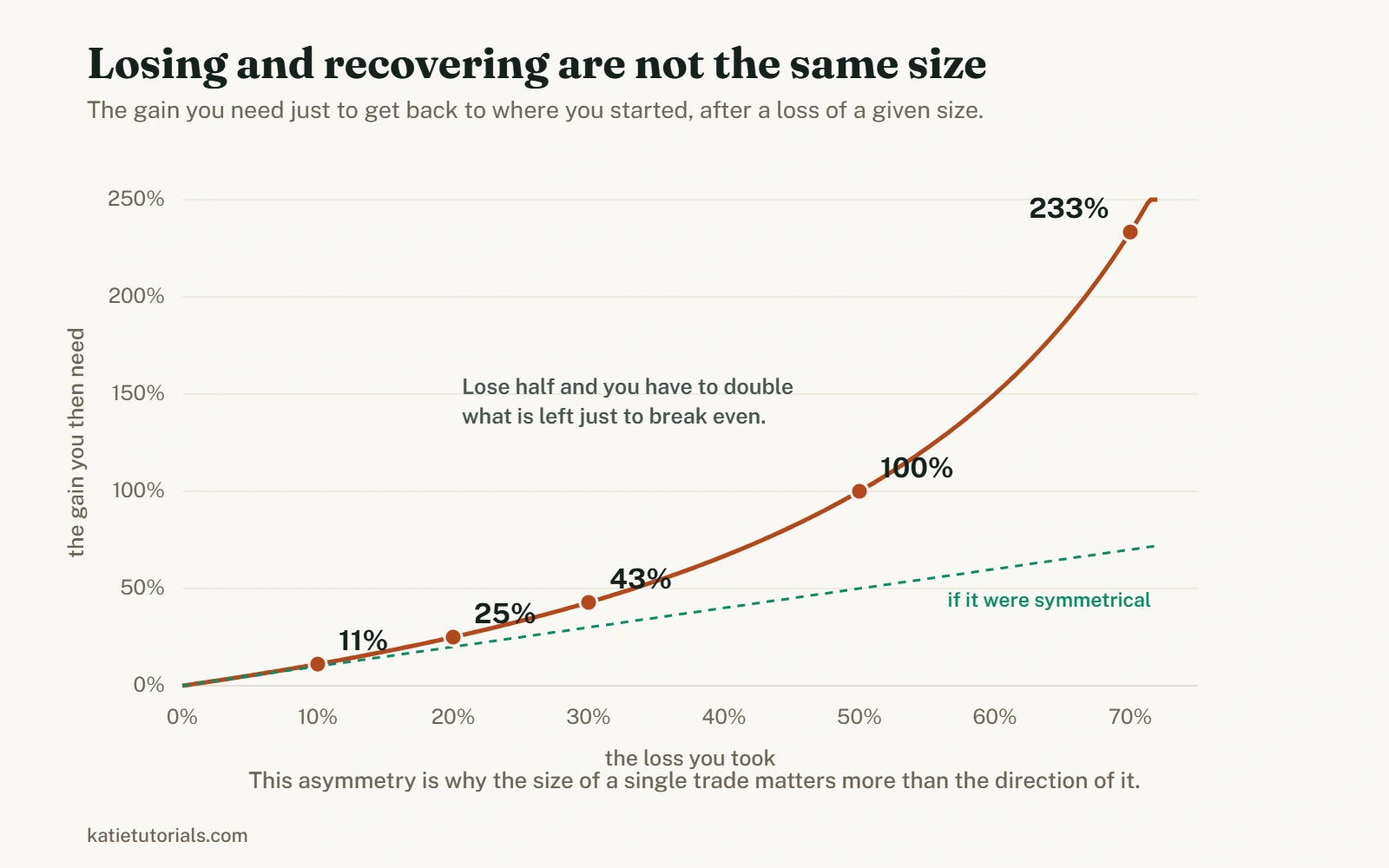
The bottom row is where most beginner accounts die. And the damage is not symmetrical, which is the part people miss. Losing money and making it back are not the same size of job.
| If you lose | You need this gain just to get back to level |
|---|---|
| 10% | 11% |
| 20% | 25% |
| 30% | 43% |
| 50% | 100% |
| 70% | 233% |
A 50% drawdown needs a 100% gain to undo. If you could reliably make 100%, you would not be reading this. That is why the usual advice is to risk 1% to 2% of the account on any single trade. There is nothing magic about those numbers. They are simply small enough that an ordinary losing streak stays survivable.
One honest caveat: position sizing does not turn a losing strategy into a winning one. It buys you enough time to find out which one you have.
2. You take profits early and let losses run
This has a name and a measurement. Terrance Odean studied 10,000 brokerage accounts and found that investors sold their winning positions at a rate of 14.8% and their losing positions at a rate of 9.8%. In other words, a winner was about 1.5 times more likely to be sold than a loser.
Then he followed what happened next. Over the following year, the winners they sold beat the losers they kept by 3.4 percentage points. The instinct was not just emotional. It was backwards.
It is easy to see why. Selling a winner books a gain, and a booked gain feels like discipline. Holding a loser avoids writing down the loss, and a loss on paper still feels like it might come back. Both are emotional decisions dressed up as a plan.
The fix is not willpower. It is deciding both exits before you enter, and then treating them as already made. More on that in when to exit a trade.
3. You trade far more often than you think
Brad Barber and Terrance Odean tracked 66,465 households at a discount broker from 1991 to 1996. The market returned 17.9% a year over that period. The average household earned 16.4%. The most active fifth of traders earned 11.4%.
They lost 6.5 percentage points a year, and not because they picked worse assets. It was cost. Every trade pays the spread, usually a commission, and sometimes overnight financing. Those costs are certain. The profit is not. Trade four times as often and you pay four times as much for the same uncertain edge.
Count your trades from last month. Most people guess low by half.
4. You decide where to get out only after you are in
Before you enter, your judgement is free. Nothing is at stake, so you can look at the chart and say honestly where the idea would be proved wrong.
The moment you are in, that judgement belongs to someone with money on the line, watching a number move. That person will find reasons. The level was not really broken. It is just a wick. It will come back after the news. None of these thoughts occur to you before you enter, which tells you exactly what they are.
So write three numbers before every entry:
- The price that proves the idea wrong. That is your stop.
- The price where you take the profit.
- The amount of money you lose, in your own currency, if the stop is hit.
If you cannot write all three, you do not have a trade. You have an opinion.
5. You trade bigger straight after a loss
This is the difference between an account that is down and an account that is gone.
The logic feels sound at the time. You lost 200, so a trade twice the usual size wins it back in one go. What actually happens is that you take a bigger position, on a worse setup, with less patience, while your judgement is at its worst point of the day. The next loss is double, and the size after that doubles again.
The only reliable fix is mechanical, because at that moment your judgement is simply not available. Pick a rule in advance and write it down. Two losses in a day and the platform closes. Or a maximum daily loss in money, not in percent, so you cannot argue with it.
There is a harder version of this worth naming. If you are trading with money you need for rent or bills, if you hide the size of your losses from people close to you, or if the losses are affecting your sleep, your work or your relationships, then the problem is no longer position sizing. Trading can become compulsive the same way gambling does, and the same kinds of support help. That is worth talking to someone about before reading another article about stop losses.
6. You keep no record, so you repeat the same mistake
Ask a trader who is losing why they are losing and you usually get a theory. Ask them to show you the last twenty trades and they usually cannot.
Without a record, every loss looks like its own piece of bad luck. With a record, the pattern is normally obvious within twenty trades, and it is normally one of the five things above. Keeping that record is the cheapest thing on this list and the one people skip most. There is more on how to do it in keeping a trading journal.
The mistakes that happen before the first trade
The six reasons above all happen at the screen. There is a second set that is already decided before you place anything, and because they are invisible during the trade they rarely get the blame.
There is no written plan
Not a strategy in your head. Written down, somewhere you can read it back: what setup you take, what size, where you get out, and what makes you stop for the day. If it is not written, it cannot be broken. That sounds like freedom and is actually the problem. You cannot improve something that has no fixed version to compare against.
Trading on tips, signals and other people’s conviction
A borrowed trade has no exit, because the confidence came from someone else and it does not transfer. When it goes against you there is nothing to consult. This is also why a losing signal service is so hard to quit: you never built the thing that would tell you it was not working.
Not knowing what a round trip costs you
Most beginners can name the profit they are aiming for but not the cost of getting in and out. Spread, commission, and overnight financing where it applies. Those come out of every trade, winners and losers alike, and at small sizes they are a much bigger share of the result than people expect.
| If a round trip costs | And you aim for | The cost is this much of your target |
|---|---|---|
| $2 | $20 | 10% |
| $2 | $50 | 4% |
| $2 | $100 | 2% |
| $5 | $20 | 25% |
The top and bottom rows are why small, frequent trades are so much harder than they look. On those, you are not competing with the market. You are competing with your own costs first.
Trading five things at once in the first month
Every instrument has its own hours, its own normal range, its own reaction to news. Watching five means learning none of them. It also means you can never tell whether a losing week was the strategy or the fact that you did not know one of them moves at 3pm. One instrument until you have fifty trades in it.
If you want the short version of all ten reasons on this page, it is that almost none of them are about reading the chart.
How to find out which one is yours
Take the next twenty trades and log seven things. Not a fancy spreadsheet, a notebook is fine.
- Date and instrument.
- Why you entered, in one sentence, written before you clicked.
- The stop and target you planned.
- Where you actually got out.
- The percentage of the account you risked.
- Whether you followed your own plan, yes or no.
- How you felt, in two or three words.
Then read the twenty back and count. If the risked percentage moves around, reason one. If your losses are consistently bigger than your wins, reason two. If there are more rows than you expected, reason three. If the planned and actual exits keep disagreeing, reason four. If the size jumps after a red row, reason five.
The yes or no column is the most useful thing on the page. It separates two completely different problems. If you followed your plan and still lost, the strategy is the problem. If you did not follow it, the strategy was never tested, and changing it would tell you nothing.
The nine months I blamed the wrong thing
I spent close to nine months losing, and for most of that time I was sure the problem was the strategy. Every losing run sent me looking for a better one. A different indicator, a different set of rules, something that was not broken.
The strategy was not what was broken. There was no risk management at all. I had no fixed amount I was willing to lose on a trade, so the size moved with how certain I felt, and I always felt most certain right before the worst decisions.
When I finally fixed the amount I would risk on any single trade and stopped moving it, the run of losses ended. Not because my analysis improved that week, because it did not. The same calls, sized properly, stopped piling up into a hole I could not climb out of.
That one change is what kept the account from reaching zero, and it is why the first item on this list is position size rather than anything to do with entries.
The one change that moves the number most
If you only fix one thing, fix the size. It is arithmetic rather than judgement, so it works even on the days when your judgement does not.
Work it out in this order, before the entry:
- Account is 2,000. One percent of it is 20. That is the most this trade may cost you.
- Entry is 50.00 and the stop is 47.00, so each unit puts 3.00 at risk.
- 20 divided by 3 is 6. You buy 6 units, not the number that felt right.
The order matters. Most losing traders choose the size first and then look for a stop that fits it. Do it the other way round: the market decides your stop and the maths decides your size. For more on this, see managing risk in trading.
Common questions
What is the biggest mistake in trading?
Measured by how fast it ends accounts, risking too much on one trade. Measured by how many people it affects, having no written plan, because every other mistake on this page gets easier when there is nothing to break. The two are related: a plan is mostly a set of decisions about size, made while you were calm.
Would a bigger account fix this?
No. Every number above is a percentage, and percentages do not care how much is in the account. A trader who risks 20% per trade loses a 50,000 account the same way they lost a 500 one, just more slowly at first and more expensively at the end.
Should I go back to a demo account?
For learning the platform, yes. For fixing any of the six reasons above, mostly no. Five of the six are emotional, and the emotion is not there when the money is not real. A very small live account teaches you more about yourself than a large demo one.
How long until I stop losing?
There is no honest number, and anyone who gives you one is selling something. What you can measure is whether your average loss is getting smaller and whether the yes or no column in your journal is turning into mostly yes. Those two move before the balance does.
Is it my strategy or is it me?
Twenty logged trades will tell you, and nothing else will. Most people assume it is the strategy, change it, and so never reach twenty trades of any single approach. That is its own reason for losing money, and probably the most common one of all.
The short version
The traders who stop losing money rarely do it by finding a better signal. They do it by making each trade small enough that being wrong is survivable, by taking fewer of them, by writing the exit before the entry, and by keeping a record honest enough to argue with.
None of that is exciting, and none of it is for sale. It is just what is left once you remove everything that does not work.