
Revenge trading is taking a position to win back a loss rather than because the setup is there. It is not stopped by willpower in the moment, because the moment is exactly when your judgement is gone. It is stopped by a rule you wrote earlier, when you were calm, that takes the decision out of your hands.
I know this because it cost me 8,000 dollars to learn it.
The day it cost me 8,000 dollars
It was 15 November, and it turned out to be the most expensive lesson of my career.
The first position of the morning went against me. I took the loss. That part was normal, and if the day had ended there it would have been an ordinary red morning that I would not remember. Instead of stopping, I followed the feeling. I wanted the money back quickly, so on the next position I doubled the size.
The market did not forgive it. Price went against me again, and in fifteen minutes I gave back the entire previous month of work. Eight thousand dollars. It was a financial hit and a psychological one, and the second one lasted longer.
After that day I wrote one iron rule into my journal, and it is still there:
The moment the daily loss limit is reached, the platform closes for 24 hours. Unconditionally. No increasing position size, no getting even with the market.
That lesson cost 8,000 dollars. The rule has since saved me a great deal of money, and considerably more peace of mind. Everything below is the long version of why it works.
What revenge trading actually looks like
It is rarely dramatic while it is happening. Nobody thinks “I am now revenge trading.” It feels like urgency, and urgency feels like being decisive.
The sequence is almost always the same:
- A loss arrives, often early in the session.
- The next entry comes faster than usual, with less checking.
- The size is bigger, and the reason given is that a bigger win fixes the day.
- The stop is wider, or there is no stop, because a normal stop would not recover enough.
- If that trade loses, the next one is bigger again.
The tell is not the emotion. It is the arithmetic. If your position size went up right after a red trade, you were revenge trading, whatever you were telling yourself at the time.
What it costs, in numbers
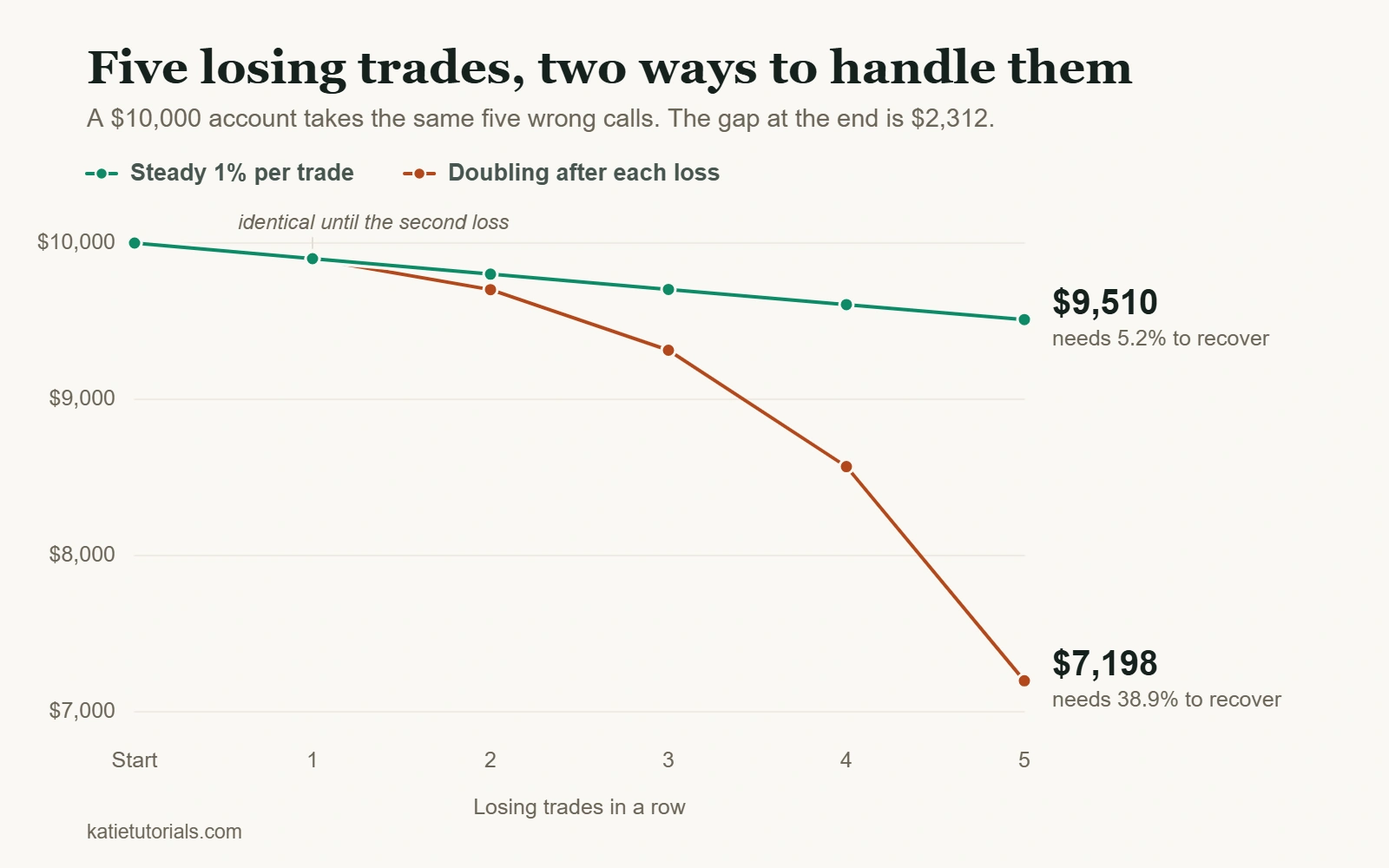
This is the part no one shows you. Below are two traders with a 10,000 dollar account having exactly the same bad day, five losing trades in a row. One risks a steady 1% each time. The other doubles the risk after every loss.
| After | Steady 1% each trade | Doubling after each loss |
|---|---|---|
| Start | $10,000 | $10,000 |
| 1 loss | $9,900 | $9,900 |
| 2 losses | $9,801 | $9,702 |
| 3 losses | $9,703 | $9,314 |
| 4 losses | $9,606 | $8,569 |
| 5 losses | $9,510 | $7,198 |
| Gain needed to get back to 10,000 | 5.2% | 38.9% |
Same five wrong calls. Same strategy. The difference is 2,312 dollars, and more importantly the difference between a week of normal trading to recover and a month of it.
Five losses in a row is not unusual, by the way. A coin produces five tails in a row roughly once in every 32 attempts. The disciplined column survives that. The other column is how accounts die.
Why it happens
Three well documented biases stack on top of each other, and you do not get to opt out of them.
- Loss aversion. A loss registers more strongly than a gain of the same size. Kahneman and Tversky measured this decades ago and it has held up ever since. So a 200 dollar loss does not create a desire for a 200 dollar gain. It creates a much larger urge.
- The sunk cost trap. The money is already gone, but it does not feel gone. It feels recoverable, and specifically recoverable from the same market that just took it.
- Break-even anchoring. Once you are down, the goal quietly stops being “trade well today” and becomes “get back to zero.” Those are different games, and the second one has no exit.
Notice that none of these are fixed by knowing about them. I knew all three on 15 November.
Six rules that actually stop it
Every rule below has the same shape: it is decided in advance, and it is mechanical. Nothing here depends on you being sensible at the worst moment of your day.
1. A daily loss limit, written in money
Not in percent. Percent is abstract and easy to argue with. A number in your own currency is not. Write the amount, and write what happens when it is hit, which is that the platform closes.
Mine closes for 24 hours. The length matters less than the fact that it is not negotiable in the moment.
2. A cool-down you cannot override
After any loss, a fixed gap before the next entry. Fifteen minutes is enough for most people. Set a timer on your phone rather than deciding by feel, because by feel the gap becomes ninety seconds.
3. Position size fixed before the session starts
Work out the size once, before the market opens, and do not recalculate it during the day. If your size is a decision you make twenty times a session, one of those twenty decisions will be made angrily.
There is more on how to calculate it in managing risk in trading.
4. A physical interruption
Stand up. Leave the room. Anything that breaks the posture of staring at the screen. This sounds trivial and it is the rule people skip, but the urge to re-enter is partly physical and it fades faster when you are not sitting in front of the chart.
5. Stop using the word “recovery”
The account does not know what it lost. There is no such thing as winning money back, there is only the next trade, which is either a good one or a bad one on its own terms. The moment you catch yourself thinking about recovering something, the trade you are about to take is not about the market.
6. A post-loss protocol written while calm
One index card, written on a good day, listing exactly what you do after a losing trade. Close the platform. Write the loss in the journal. Timer. Walk. Then, and only then, decide whether there is a setup.
You are not writing this for today. You are writing it for the version of yourself who will not be able to write it.
When it is not discipline, it is something else
This is the part broker blogs and course sellers do not write, because it is bad for their business. I am not selling anything, so here it is.
Sometimes the problem is not technique. Research published in Frontiers in Psychiatry in 2021 by Hakansson, Fernandez-Aranda and Jimenez-Murcia reports that around 8% of financial market investors may meet the criteria for problem gambling in relation to their trading, and describes rapid day trading as a recognised route to over-indebtedness and mental health problems.
The economics point the same way. In 2020 Chague, De-Losso and Giovannetti studied everyone who began day trading in the Brazilian equity futures market between 2013 and 2015. Of those who persisted for more than 300 days, 97% lost money, and only 1.1% earned more than the Brazilian minimum wage. The people who kept going were not the ones who eventually won. Persistence on its own was not the missing ingredient.
So it is worth asking honestly whether any of this describes you:
- You are trading with money that is needed for rent, bills or debt.
- You hide the size of your losses from people close to you.
- You have told yourself you would stop, more than once, and did not.
- The losses are affecting your sleep, your work or your relationships.
- You feel worse after winning days than you expect to.
If several of those are true, no article about stop losses is going to help, and a daily loss limit will just be one more rule you break. This is the same territory as gambling, it is treated the same way, and talking to a doctor or a gambling support service is a reasonable first step rather than a dramatic one. There is no version of this where the market fixes it for you.
How to spot it in your own journal
If you already keep a record, you do not have to rely on memory. Read back your last twenty trades and look for these five patterns. Each one has a specific meaning.
| What you see in the log | What it means |
|---|---|
| Size is larger than the previous trade, and the previous trade was red | A revenge trade, regardless of how the entry was justified |
| Under fifteen minutes between a loss and the next entry | No cool-down. The decision was made by the loss |
| The “why I entered” note is vague or empty on that row | There was no setup. There was a need |
| You exited somewhere other than your planned stop | The plan was abandoned mid trade |
| Same instrument re-entered within the hour after losing on it | Chasing the specific thing that hurt you |
Two or more of these in twenty trades is a pattern rather than a bad day. If you are not keeping a record yet, start with keeping a trading journal, because without one every loss looks like its own isolated piece of bad luck.
Common questions
Is it true that 90% of traders lose money?
The 90% figure gets repeated everywhere and has no single study behind it. What is documented is not kinder. The European Securities and Markets Authority reviewed retail CFD accounts across EU jurisdictions and found that 74% to 89% lose money. The Brazilian day trading study above found 97% among those who persisted beyond 300 days. So the honest answer is that 90% is folklore, and the real numbers sit on either side of it.
What is the 90% rule in trading?
It is usually quoted as “90% of traders lose 90% of their money in 90 days.” It is a saying, not a finding. No one has ever produced the study behind it. Use the ESMA and Brazilian figures instead when you want a number you can stand behind.
Is it true that 99% of traders fail?
No source says 99% exactly. The closest real figure is from the Brazilian study, where 98.9% of persistent day traders failed to earn even the minimum wage from it. That is probably where the feeling comes from. The important word in that finding is “persistent”, because these were people who kept going for more than 300 days.
Does a bigger account make revenge trading less dangerous?
No. Every number in the table above is a percentage, and percentages do not care about the balance. Doubling after each loss destroys a 100,000 account in exactly the same number of trades as a 10,000 one. The only thing that changes is how much it costs.
The short version
Revenge trading is not a character flaw and it is not rare. It is what happens when a decision that should have been made in advance gets made by someone who has just lost money.
Write the daily loss limit in money. Decide now what happens when it is hit. Make the platform close, not your willpower. And if you read the list in the section above and recognised yourself in most of it, deal with that first, because no rule survives contact with a problem it was not designed for.
Mine cost 8,000 dollars to write. Yours can cost nothing.
3 thoughts on “How to Stop Revenge Trading”