
Discipline is not a personality trait that some traders were issued and you were not. It is what is left over once you have removed the decisions, and removing decisions is an engineering job rather than a character test.
Every piece of advice that ends in “just stick to your plan” is describing the finish line and calling it directions.
Willpower is the wrong tool for this
Willpower is a resource that runs down through the day, and it runs down fastest under exactly the conditions trading creates: uncertainty, money at risk, and fast feedback. Asking it to hold the line at 2pm after two losses is asking it to work at the one moment it is least available.
So a disciplined trader is not someone who resists more. It is someone who has arranged things so there is less to resist. The question is never “how do I make myself follow the rules”, it is “how do I make breaking them require effort”.
Mechanical rules and aspirational ones
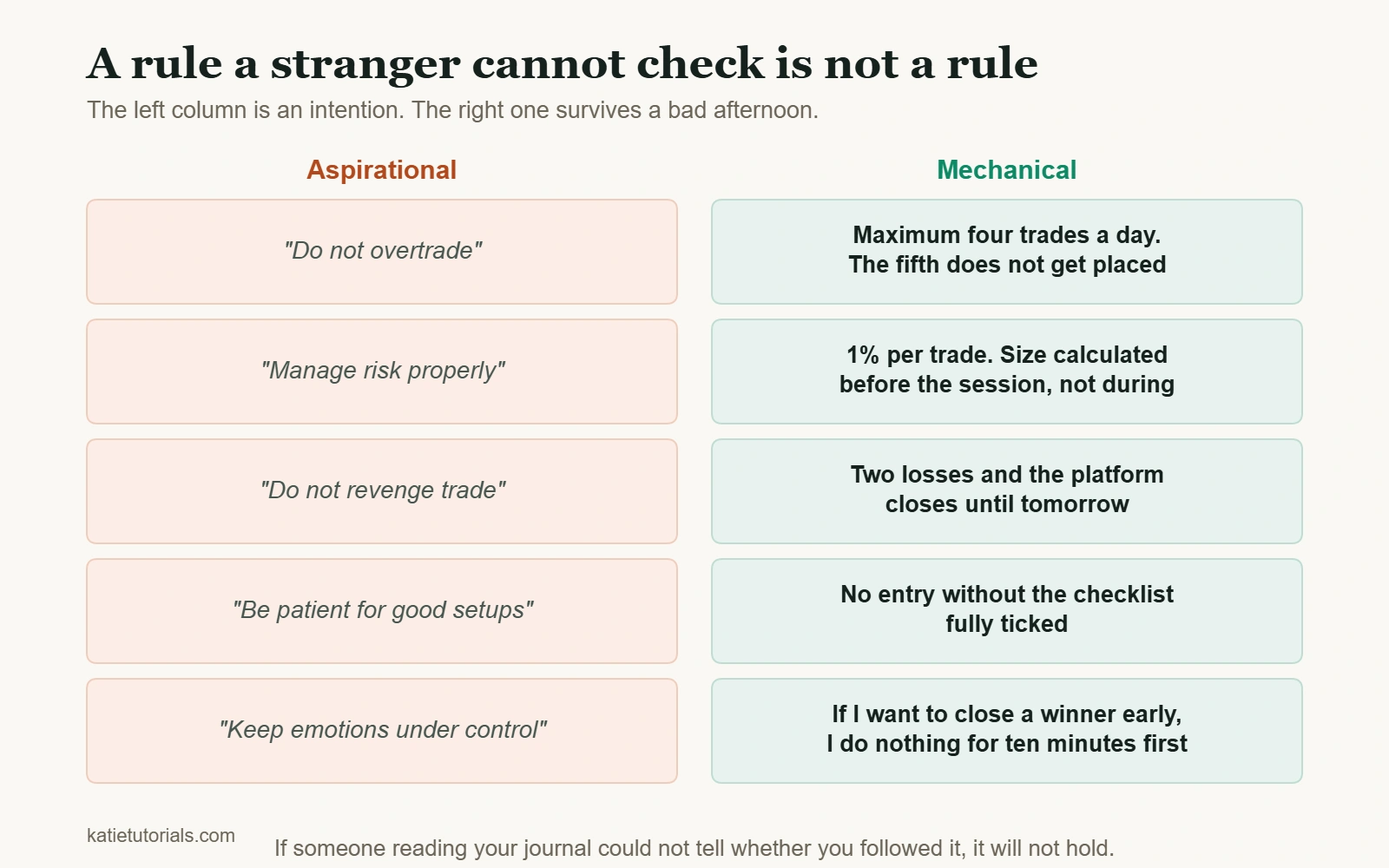
Most trading rules fail because they were never rules. They were intentions with a number attached.
| Aspirational, will not hold | Mechanical, will |
|---|---|
| “Do not overtrade” | “Maximum four trades a day. The fifth does not get placed” |
| “Manage risk properly” | “1% per trade. Size is calculated before the session and not recalculated” |
| “Do not revenge trade” | “Two losses and the platform closes until tomorrow” |
| “Be patient for good setups” | “No entry without the checklist below fully ticked” |
| “Keep emotions under control” | “If I want to close a winner early, I do nothing for ten minutes first” |
The test for any rule is whether a stranger could check it. If someone reading your journal could not tell whether you followed it, it is not a rule and it will not survive a bad afternoon.
The checklist is the highest leverage habit there is
One page, five to seven lines, in front of you before every entry. Not because you will forget the items but because ticking them takes long enough for the urge to pass.
A workable version:
- The setup matches one written definition, and I can name which.
- I have written the entry reason in one sentence, before clicking.
- Stop and target are both identified on the chart.
- Size is calculated from the risk, not chosen.
- This is not my fifth trade today.
- I am not entering within fifteen minutes of a loss.
- I would be comfortable holding this position through normal noise.
The last line catches more bad trades than the other six combined. If the honest answer is no, the size is wrong, and that is a faster diagnosis than any amount of self examination.
Build the routine around the session, not inside it
Discipline during the session is mostly determined before it starts.
| When | How long | What happens |
|---|---|---|
| Before the session | 10 minutes | Size calculated. Daily loss limit written down. Watchlist fixed. Checklist visible |
| During | — | No new decisions. Only execution of things already decided |
| After the last trade | 5 minutes | Journal filled in while the mood is still accurate |
| Weekly | 20 minutes | Count the rule breaks. Not the profit |
| Monthly | 1 hour | Sort the record. Look for patterns by day, hour and setup |
The middle row is the point of the whole table. If you find yourself making a decision during the session that you did not make before it, that is the moment discipline is being spent, and it is the moment to notice rather than to push through.
What to do when you break a rule
Everyone tells you to follow your rules. Almost nobody tells you what to do afterwards, which is strange, because breaking them is the normal case and how you handle it decides whether the system survives.
Three things, in this order:
- Write it down as a break, not as a trade. Mark it N in the journal even if it won. Especially if it won, because a rule break that pays is the one that teaches you to do it again.
- Do not add a punishment rule. People respond to a break by adding three more rules, which makes the system heavier and the next break more likely. Keep the count of rules small enough to hold in your head.
- Ask whether the rule was wrong. Sometimes a rule you keep breaking is badly designed rather than too demanding. A rule broken once is a discipline problem. A rule broken eight times out of ten is a bad rule, and the honest move is to redesign it, not to keep failing it.
That third point is the one most articles will not say, because it sounds like permission. It is not permission, it is maintenance. A rule that cannot be followed is doing nothing except training you to ignore your own system.
Measure discipline separately from profit
This is the part that makes the rest work. Profit is a poor measure of discipline, because as covered in why trading is so hard, a broken rule can pay and a followed one can lose.
So keep one number that has nothing to do with money: the percentage of trades where you followed your own plan. It comes straight out of the Y and N column in your journal.
| Followed the plan on | What it means |
|---|---|
| Under 50% | You have no strategy yet, only intentions. Nothing else can be assessed |
| 50% to 80% | Normal for a first year. Find which rule is doing the breaking |
| Over 90% | The strategy can now be judged on its own results, which is the point |
That number improves within weeks, long before the balance does, which makes it the only encouraging measurement available early on. It is also the only one you fully control.
Habits worth building, in order
Adding all of these at once is how people end up with none of them. One at a time, two weeks apart.
- Write the entry reason before clicking. Cheapest, highest return, and it silently prevents a percentage of trades from happening at all.
- Calculate size from risk. Removes the single most damaging decision from the session.
- Fill in the journal the same day. A record written a week later is fiction.
- Hold a hard daily loss limit. The one that turns a bad day into a bad day rather than a bad month.
- Review weekly and count the N rows. Turns all the above into information instead of admin.
Common questions
How do I stop breaking my own trading rules?
Make the rules mechanical, keep them few, put the checklist where you have to look at it, and add friction to the actions you want less of. If a rule still breaks repeatedly after that, redesign the rule. Repeatedly failing a rule is data about the rule.
How long does it take to become disciplined?
The plan-following percentage usually moves within a few weeks, because it depends on setup rather than on character. What takes longer is trusting it during a losing streak, and that is less about discipline than about knowing what a normal streak looks like.
Is discipline more important than strategy?
They are not comparable, because without discipline you cannot find out whether the strategy works. An untested strategy and a broken one look identical from the outside. Discipline is what makes the strategy measurable, which has to come first.
What if I only break rules on losing days?
That is the most common pattern and it is not a discipline failure in general, it is one specific trigger. Deal with the trigger rather than the whole system, starting with what happens after a loss.
The short version
Write few rules, make each one checkable by a stranger, decide everything before the session, tick a checklist before every entry, and log the breaks honestly including the profitable ones.
Then measure the percentage of trades where you followed your plan, and treat that as your score. The money is a separate conversation, and a much slower one.