
Trading is not hard because the ideas are complicated. Buy low and sell high fits on a postcard, the platform has two buttons, and the charts are free. It is hard for structural reasons that have almost nothing to do with how clever or disciplined you are.
Those reasons are worth understanding on their own, because most of the advice you will read treats difficulty as a personal failing. It usually is not.
You are learning from a teacher who lies
In almost every skill worth having, doing the right thing produces a good result fairly soon. Hit the ball correctly and it goes where you aimed. Write the code correctly and it runs. The feedback is honest, which is what lets you learn at all.
Trading does not work like that. A good decision loses regularly and a bad decision wins regularly, and neither tells you which it was.
| The trade won | The trade lost | |
|---|---|---|
| Good decision | Deserved. Teaches the right lesson | Correct and punished anyway. Feels exactly like failure |
| Bad decision | Rewarded. Teaches the wrong lesson, and loudly | Deserved. Teaches the right lesson |
Two of those four cells teach you something true. The other two actively mislead, and the worst one is the top right and bottom left pair, because that is where a disciplined trader gets punished and a reckless one gets paid.
This is the deepest reason trading is hard, and it is why every serious approach eventually involves judging your decisions separately from your results. That separation is the entire purpose of the “did I follow my plan” column in a trading journal.
The feedback takes hundreds of trades to become trustworthy
Suppose you have a real edge and win 55% of the time. How many trades before you could reasonably tell that apart from a coin?
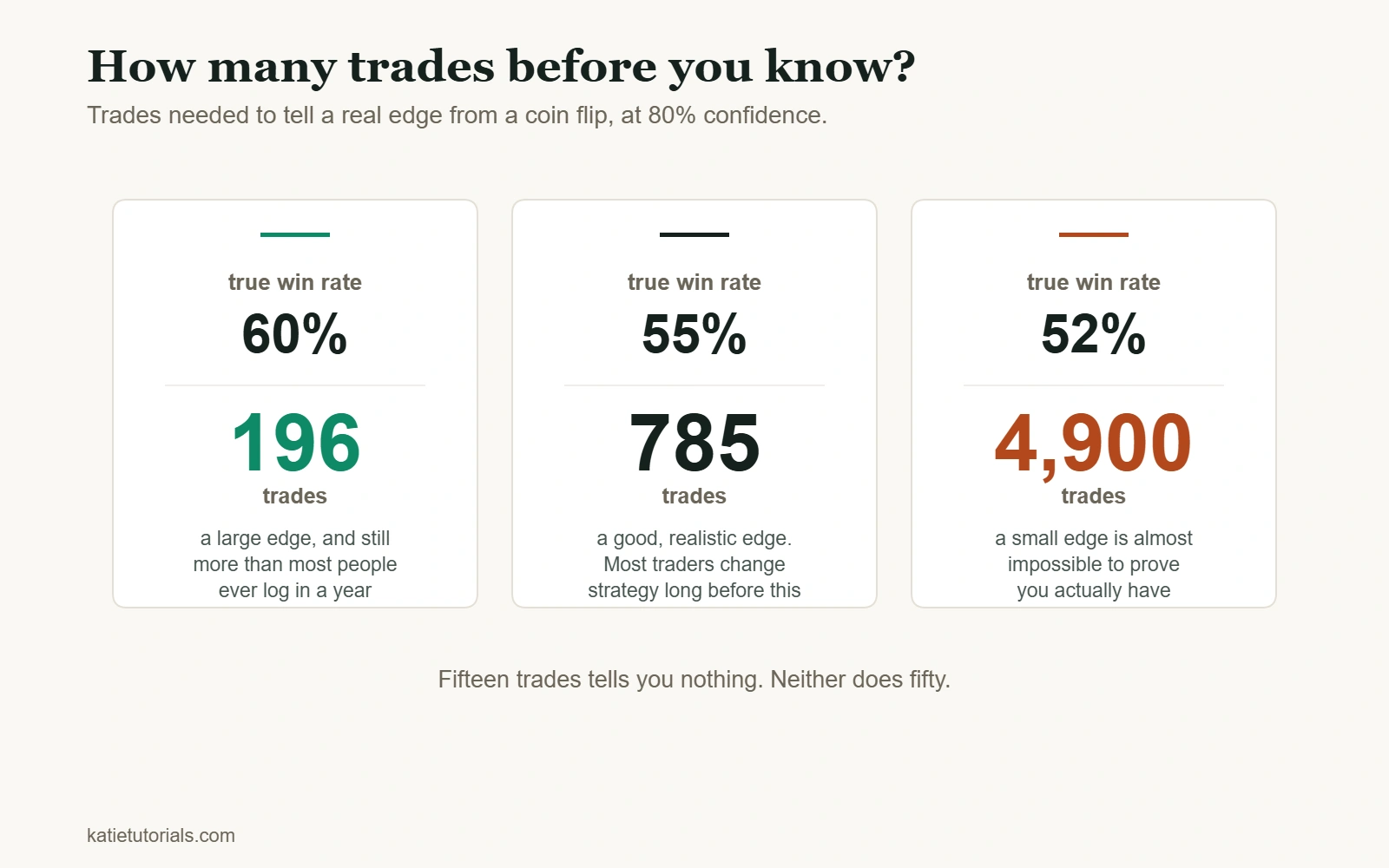
This is a standard statistical question with a standard answer, and the answer is uncomfortable. To detect a 55% win rate against a 50% baseline with 80% confidence, you need roughly 785 trades.
| If your true win rate is | Trades needed before you could tell it from a coin flip |
|---|---|
| 60% | about 196 |
| 55% | about 785 |
| 52% | about 4,900 |
Most people change strategy after fifteen bad trades. On these numbers, fifteen trades tells you essentially nothing, and neither does fifty. A trader who switches approach every month is not gathering evidence, they are gathering noise, and they will do this for years while believing they are learning.
This is also why a strategy with a genuinely small edge is nearly impossible to trade on purpose. You would be dead or bored long before the sample proved anything.
Normal randomness looks exactly like being broken
Even with a decent strategy, losing runs are not unusual. They are close to guaranteed, and they are longer than intuition suggests.
Over a hundred trades, here is the chance of hitting at least one losing streak of a given length:
| Your win rate | Chance of 5 losses in a row | Chance of 8 in a row |
|---|---|---|
| 50% | 81% | 17% |
| 45% | 92% | 31% |
| 40% | 98% | 49% |
At a 45% win rate, which is perfectly profitable at a 2 to 1 reward ratio, you are 92% likely to hit a five loss streak inside a hundred trades and roughly one in three likely to hit eight in a row.
Eight consecutive losses does not feel like variance. It feels like the strategy has stopped working, like the market has changed, like you have lost whatever you had. That feeling arrives on schedule for people whose strategy is fine, and it is the point at which most of them abandon it and start again from zero.
The costs are certain and the profits are not
Every trade pays the spread, usually a commission, and sometimes overnight financing. Those are charged whether you are right or wrong. The profit is a probability.
Brad Barber and Terrance Odean tracked 66,465 households at a discount broker from 1991 to 1996. The market returned 17.9% a year. The average household earned 16.4%, and the most active fifth earned 11.4%. The gap was not bad stock picking, it was turnover.
So activity itself has a price, and it is charged in advance. Doing more of something you are not yet good at costs more than doing less of it, which is the reverse of how most skills reward practice.
Persistence on its own does not fix it
The usual answer to all of this is to keep going. It is worth knowing what happened to the people who did.
In 2020 Chague, De-Losso and Giovannetti studied everyone who began day trading in the Brazilian equity futures market between 2013 and 2015. Among those who persisted for more than 300 days, 97% lost money. Only 1.1% earned more than the Brazilian minimum wage, and 0.5% more than a bank teller’s starting salary.
Read the condition again, because it is the finding. These were not people who quit early. They were the ones who stuck at it, and sticking at it was not the missing ingredient. Persistence is necessary and it is nowhere near sufficient, and most encouragement you will read quietly assumes the opposite.
The market does not sit still while you learn it
A tennis court has the same dimensions next year. A market does not. Volatility regimes change, correlations break, and the behaviour that a pattern depended on can simply stop.
Worse, the opponent adapts. You are not trading against difficulty, you are trading against other participants, many of whom are faster, better capitalised and automated. Any edge that becomes widely known gets arbitraged away by the people who find it first. This is the only skill on the list where getting better does not guarantee you keep up.
And it is designed to look easy
Everything above would be manageable if the difficulty were visible. It is not.
There is no entrance exam, no apprenticeship, no licence, and no minimum. The interface is two buttons, the charts look like the ones professionals use, and the first few trades are often profitable through pure chance. Nothing in the experience signals what you are actually undertaking, and a whole industry is funded by keeping it that way.
Compare that with any other activity with a 74% to 89% failure rate. It would come with warnings on the door. Here the warning is one line of small print at the top of the broker’s website, which regulators had to insist on.
What actually makes it less hard
None of this argues for giving up. It argues for changing what you expect the first year to produce, and for building against the specific problems above rather than against a vague sense of difficulty.
- Trade one instrument until you have fifty trades in it. You cannot learn five things whose behaviour you cannot yet distinguish from noise.
- Keep one strategy long enough to gather a sample. Given the numbers above, switching monthly guarantees you never learn anything.
- Judge the decision, not the result. The record of whether you followed your plan is more informative than the profit and loss, and it is available immediately.
- Size so that an eight loss streak is survivable. Not so it is unlikely, because it is not unlikely. See managing risk in trading.
- Expect the streak before it arrives. Most people quit a working method during a run that the arithmetic said was coming.
Common questions
How should a beginner start trading?
Smaller and slower than feels reasonable. One instrument, one strategy, a written plan, a record of every trade, and a position size where being wrong eight times in a row is survivable. The first goal is not profit, it is accumulating enough trades of one approach to find out whether it does anything.
Can I make $1,000 a day trading?
Some people do. The Brazilian study above puts the share of persistent day traders earning more than a minimum wage at 1.1%, so as a plan for your own next twelve months it is not a reasonable expectation, and anyone presenting it as one is selling something. The honest version of the question is what account size and what return would be needed, and the arithmetic there is usually sobering enough to answer it.
Is trading harder than investing?
For most people, considerably. Investing over long horizons has fewer decisions, lower costs and a naturally rising baseline to ride. Trading removes all three of those advantages and adds the feedback problem at the top of this page. That does not make trading wrong, it makes it a different activity with a much steeper cost of learning.
Does it get easier?
The mechanical parts do, quickly. Sizing, order entry, keeping the record. The feedback problem never goes away, because it is a property of the market rather than of you. What changes is that you stop expecting individual results to mean anything, which is less satisfying than it sounds and is most of what separates people who last from people who do not.
The short version
Trading is hard because the feedback lies, the sample needed to trust it is enormous, ordinary randomness produces streaks that feel like failure, costs are charged in advance, the market adapts, and none of that is visible from the outside.
Almost none of it is a statement about you. Knowing that is worth more than another indicator, because the people who quit are rarely the ones who were doing it worst. They are the ones who thought eight losses in a row meant something.