
The list of factors is short and you can learn it in ten minutes. Interest rates, inflation, employment, growth, company earnings. Every article on this subject gives you that list and stops there.
The useful part is the thing the list leaves out, which is that markets do not move on the number. They move on the gap between the number and what was already expected, and once you understand that, most of what gets sold as economic analysis stops looking like an edge.
The main factors, and which way they usually push
These are tendencies rather than laws. Each one has produced the opposite outcome plenty of times, for reasons in the next section.
| Factor | Usual effect on share prices | Why |
|---|---|---|
| Interest rates rise | Downward pressure | Borrowing costs more, future earnings are discounted harder, and bonds become a more attractive alternative |
| Inflation rises unexpectedly | Downward pressure | It raises the likelihood of rate rises, and it erodes real earnings |
| Strong employment data | Mixed | Good for company revenue, but it can also make rate cuts less likely |
| GDP growth above expectations | Upward pressure | More economic activity generally means higher corporate profits |
| Company earnings beat expectations | Upward pressure on that company | The most direct link on this list, and even it fails regularly |
| Central bank signals a policy change | Often the largest mover on the list | It changes the assumption underneath every other valuation |
Notice how many of these route through interest rates. For shares, the rate path is usually the dominant variable, because it sets what every future stream of earnings is worth today.
The part that changes everything
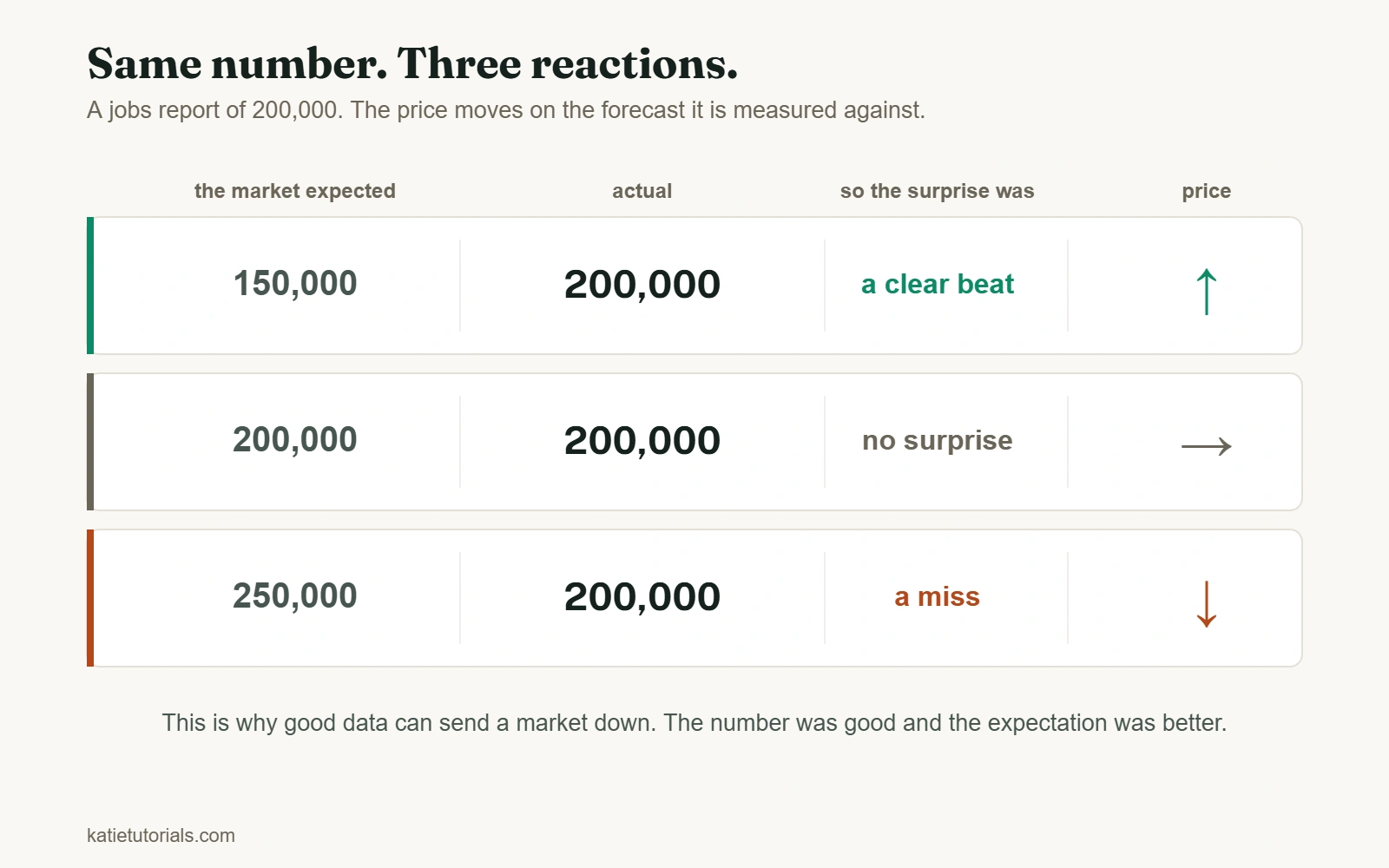
Here is the mechanism people miss. By the time a number is published, the market has already priced in what it thought that number would be. The price you see before the release contains the consensus forecast.
So the move comes from the surprise, not the level.
| Expected | Actual | The surprise | Typical reaction |
|---|---|---|---|
| 150,000 jobs | 200,000 | A clear beat | Rises |
| 200,000 jobs | 200,000 | None | Little movement |
| 250,000 jobs | 200,000 | A miss | Falls |
The actual number is identical in all three rows. This is why you will watch strong economic data arrive and see the market fall, then read commentary explaining it afterwards as though something subtle happened. Nothing subtle happened. The number was good and the expectation was better.
It also works the other way, which is more confusing to watch. Genuinely bad news can lift a market that was braced for worse.
Why the economic calendar is not an edge
This follows directly. If the move depends on the surprise, then to profit from a release you would need to know something about the number that the consensus does not, before it is published.
- You are reading the same figure at the same second as everyone else.
- Institutions have machines placed physically close to the exchange that react in microseconds. By the time you have read the headline, the first move has happened.
- Spreads widen around releases and slippage increases, so even a correct call can fill badly. There is more on that in managing risk in trading.
None of this means economic data is irrelevant. It means the data is not a trading signal for a retail account, and anyone selling a strategy built on trading the release is selling a race you are entering on foot.
What the calendar is actually for
It has a real use, and it is defensive rather than predictive.
- Knowing when volatility is coming. You can see in advance which hours carry a scheduled release and treat them as higher risk.
- Deciding not to hold through one. If a position would be badly damaged by a spike in either direction, closing it beforehand is a legitimate strategy rather than timidity.
- Explaining a move afterwards. Knowing that rates were the driver of a week helps you understand conditions, even though it would not have helped you predict them.
- Context for the longer term. If you hold positions for weeks, the rate environment matters a great deal more than it does to someone closing every day.
Which hours those are, and the other times worth avoiding, is covered in the best time of day to trade.
What matters most, by market
The same release does not carry the same weight everywhere.
| If you trade | The factors that move it most |
|---|---|
| Individual shares | Company earnings first, then the sector, then interest rates |
| Stock indices | Interest rate expectations and central bank language, above almost everything else |
| Currencies | The difference in rate expectations between the two countries, not either one alone |
| Commodities | Supply and demand specific to that commodity, plus the dollar, plus growth expectations |
| Crypto | Liquidity conditions and risk appetite. It behaves more like a high beta technology asset than a currency |
The currency row is the one most often taught wrongly. A rate rise does not strengthen a currency on its own. It strengthens it relative to a country where rates are not expected to rise, and only if the rise was not already expected.
Common questions
What economic factors affect stock prices the most?
For the market as a whole, interest rate expectations and what the central bank signals about them. For an individual company, its own earnings against what analysts forecast. Almost everything else on the usual list works by changing one of those two.
Why did the market fall on good news?
Because the news was not as good as the price already assumed, or because it made a rate cut less likely, or because the move had been anticipated and the people who expected it took their profits. All three are ordinary and none of them requires a conspiracy.
Should I trade the news?
As a beginner, no. The spread widens, the fill is unreliable, the first move happens faster than you can act, and the direction depends on a consensus figure you are not positioned to assess. Standing aside during releases is a strategy, and a defensible one.
Do I need to follow economics to trade?
You need enough to know when the calendar is busy and not to be surprised by a scheduled event. You do not need a macro view, and having one is a common way to become attached to a position that the chart has already disagreed with.
The short version
Interest rate expectations dominate, everything else mostly works through them, and the market moves on the gap between the number and the forecast rather than on the number itself.
Use the calendar to know when to be careful, not to know what will happen. The first of those is achievable and the second is what is being sold to you.