
There are hours when volume is reliably high and spreads are reliably tight, and hours when both go the other way. That part is a fact about the market and it is the same for everyone.
Then there is the part almost no article covers: the hours when you trade well, which are not necessarily the same hours, and which only your own record can tell you.
What the clock actually changes
Three things move together through the day, and everything else follows from them.
- Volume. More participants means orders get filled closer to where you wanted.
- Spread. Thin hours widen the gap between buying and selling, and that gap is a cost you pay on entry and exit.
- Volatility. More movement means more opportunity and more ways to be stopped out of a correct idea.
High volume and tight spreads are good for nearly everyone. High volatility is good for some strategies and fatal for others, which is the first reason there is no single correct answer.
The sessions, roughly
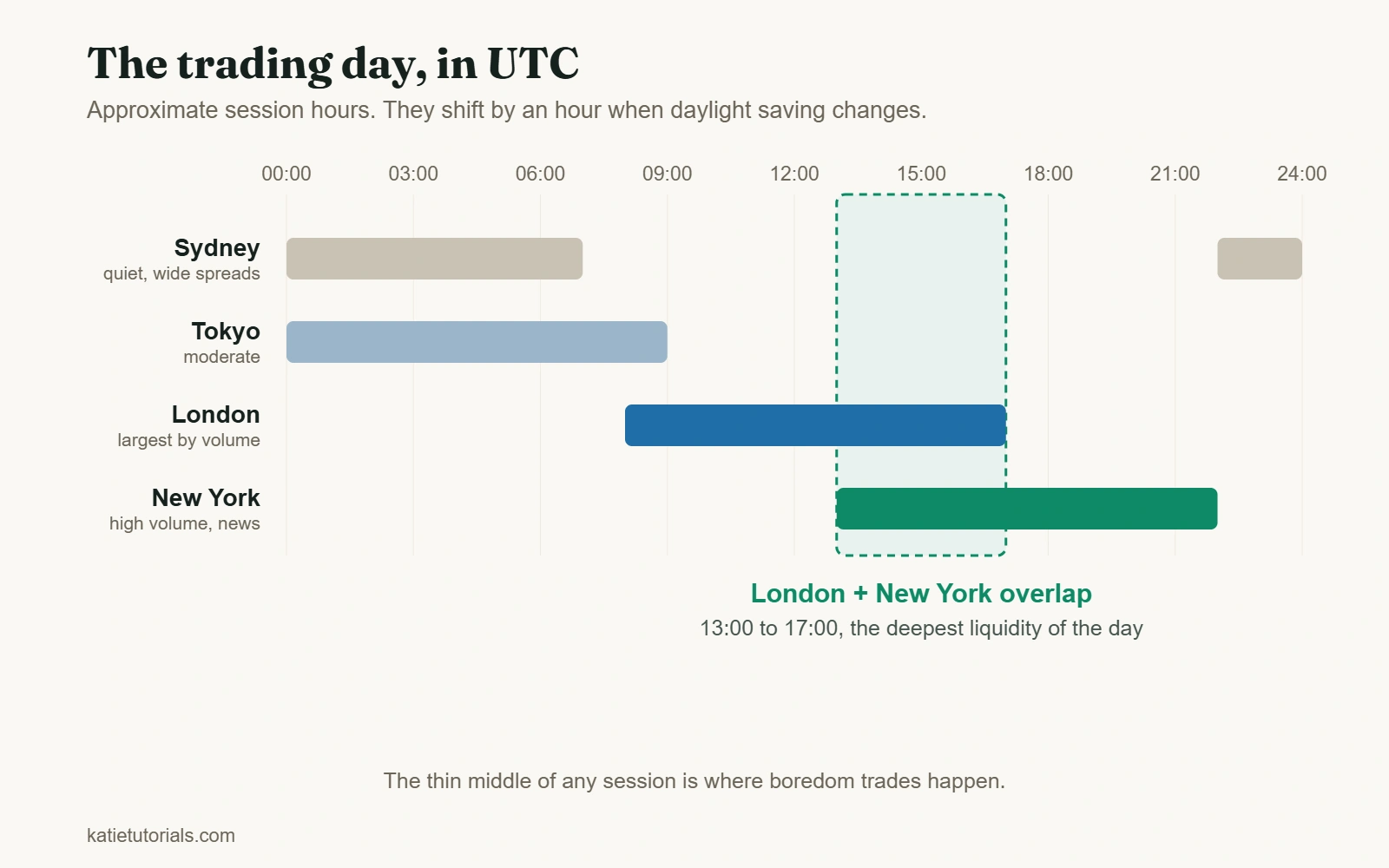
Currency markets run continuously through the week, but the activity clusters around the main financial centres. All times below are approximate and in UTC, and they shift by an hour when daylight saving changes in each region.
| Session | Approximate hours (UTC) | Character |
|---|---|---|
| Sydney | 22:00 to 07:00 | Quiet. Wide spreads on most pairs |
| Tokyo | 00:00 to 09:00 | Moderate. Most active on yen and Asian pairs |
| London | 08:00 to 17:00 | The largest single session by volume |
| New York | 13:00 to 22:00 | High volume, heavy news flow |
| London and New York overlap | 13:00 to 17:00 | The deepest liquidity of the day |
If you trade currencies and want the tightest spreads and the most participants, that overlap window is the answer. It is also the busiest four hours for economic releases, which cuts both ways.
For US shares the day is simpler: the regular session runs 14:30 to 21:00 UTC, which is 9:30am to 4:00pm in New York.
The first hour and the last hour
On any exchange traded market, the open and the close behave differently from the middle of the day.
The opening hour carries the most volume and the widest ranges. Overnight news gets priced in, and moves are large and fast. This suits momentum and breakout approaches and punishes anything that needs a calm, orderly market. It is also where beginners lose money fastest, because the size of the moves makes normal position sizing feel too small and every mistake is amplified.
The closing hour picks up again as funds rebalance and day traders flatten positions. Volume returns without the news-driven chaos of the open, which some traders find is the most workable hour of the day.
The middle, roughly the hours around lunch in the dominant session, is typically the thinnest part of the day. Ranges compress, breakouts fail more often, and the same strategy that worked at the open produces a string of small losses. A great deal of avoidable damage happens here, done by people trading out of boredom rather than opportunity.
Hours to be careful with
- The minutes around a scheduled release. Spreads widen, slippage increases, and a stop is much less likely to fill where you put it. Being right about the direction does not protect you here.
- The first few minutes of the open. Prices can move a long way before any orderly structure appears.
- Late Friday. Positions get closed for the weekend, liquidity drains, and moves become less representative of anything.
- Market holidays and the days around them. Thin books make ordinary levels behave badly.
None of these are forbidden. They are hours where the cost of being wrong goes up without the probability of being right going up to match.
Your best hours are personal, and your record knows them
Here is the part that matters more than any of the above, and I only found it by keeping a record.
When I sorted my own trades by time and day, the losses were concentrated on Friday evenings, when I was tired and was breaking my own strategy without really noticing. Nothing about the market at that hour was special. The variable was me.
That was not something I could have reasoned my way to, and it was not something any article could have told me. It came out of the journal, and the method for finding yours is in how to keep a trading journal.
Since then my rule is not “trade the London overlap”. It is “do not trade Friday evenings”, which is a far more valuable piece of information because it is true of me rather than true in general.
How to find your own hours
Once you have fifty logged trades, this takes about ten minutes.
| Sort your trades by | And look at | What it tells you |
|---|---|---|
| Hour of the day | Total result and the rule-break count | Whether a particular hour is costing you |
| Day of the week | The same two columns | Mine was Friday. Yours may be Monday |
| Session | Average win versus average loss | Whether your strategy suits that liquidity |
| Time since your last trade | Result | Whether you trade worse when you are rushing |
Count, do not read. The point is not to remember how those trades felt, it is to see totals you had no idea existed. A single bad hour repeated weekly can account for an entire losing month while every other hour is quietly profitable.
Common questions
What time of day is best to trade?
For liquidity and tight spreads in currencies, the London and New York overlap, 13:00 to 17:00 UTC. For shares, the first and last hour of the regular session. But the best time for you is whichever hours your own record shows you trade well in, and those two answers are often different.
What time should I avoid trading?
The quiet middle of the session, the minutes around scheduled news, late Friday, and any hour where you are tired. The last of those is the one that does the most damage and the only one that is not on any calendar.
Does the best time change depending on what I trade?
Yes, and this is the thing people forget when they move instruments. Each market has its own clock. A strategy tuned to the London open does not transfer to an Asian index simply because the pattern looks the same on the chart.
Is it better to trade fewer hours?
Almost always, at least at the start. Picking one two-hour window and trading only that accumulates comparable trades much faster, which is what makes a record meaningful, and it removes the boredom trades that fill the thin part of the day.
The short version
The market’s best hours are the ones with volume and tight spreads: the London and New York overlap for currencies, the open and the close for shares. Avoid the thin middle, the minutes around news, and late Friday.
Then find your own hours from your own record, because the general answer and the personal one are rarely the same, and only one of them is about you.