
You cannot remove emotion from trading, and every article that tells you to “stay disciplined” is describing the result rather than the method. Discipline is what it looks like from outside when something else is working.
What actually works is narrower than it sounds. There are two states that break a trading plan, they break it in opposite directions, and they need opposite corrections. Almost everything else is a variation of one of them.
The trade where greed wore a disguise
I had three losing trades in a row once and I panicked. It was not fear that took over, it was greed. I doubled up to win the money back quickly, with no technical analysis behind it at all. I lost that one too.
That was the moment I understood that the market is not aware of my emotions and has no interest in them. It was not punishing me and it was not owed anything.
Now, the moment I notice greed or fear making the decision, I turn the screen off until my head is clear.
The part worth pulling out is that it did not feel like greed at the time. It felt like taking responsibility, like fixing something. That is the problem with both of these states. Neither one announces itself. They arrive wearing the costume of a reasonable decision, which is why recognising them has to be mechanical rather than a matter of noticing how you feel.
Fear and greed are not the same problem
Most advice treats emotion as one thing and prescribes one cure, usually “take a break”. But the two states damage a plan in opposite ways, and a fix aimed at one can make the other worse. Telling a fearful trader to be bolder and a greedy trader to be bolder are not the same instruction.
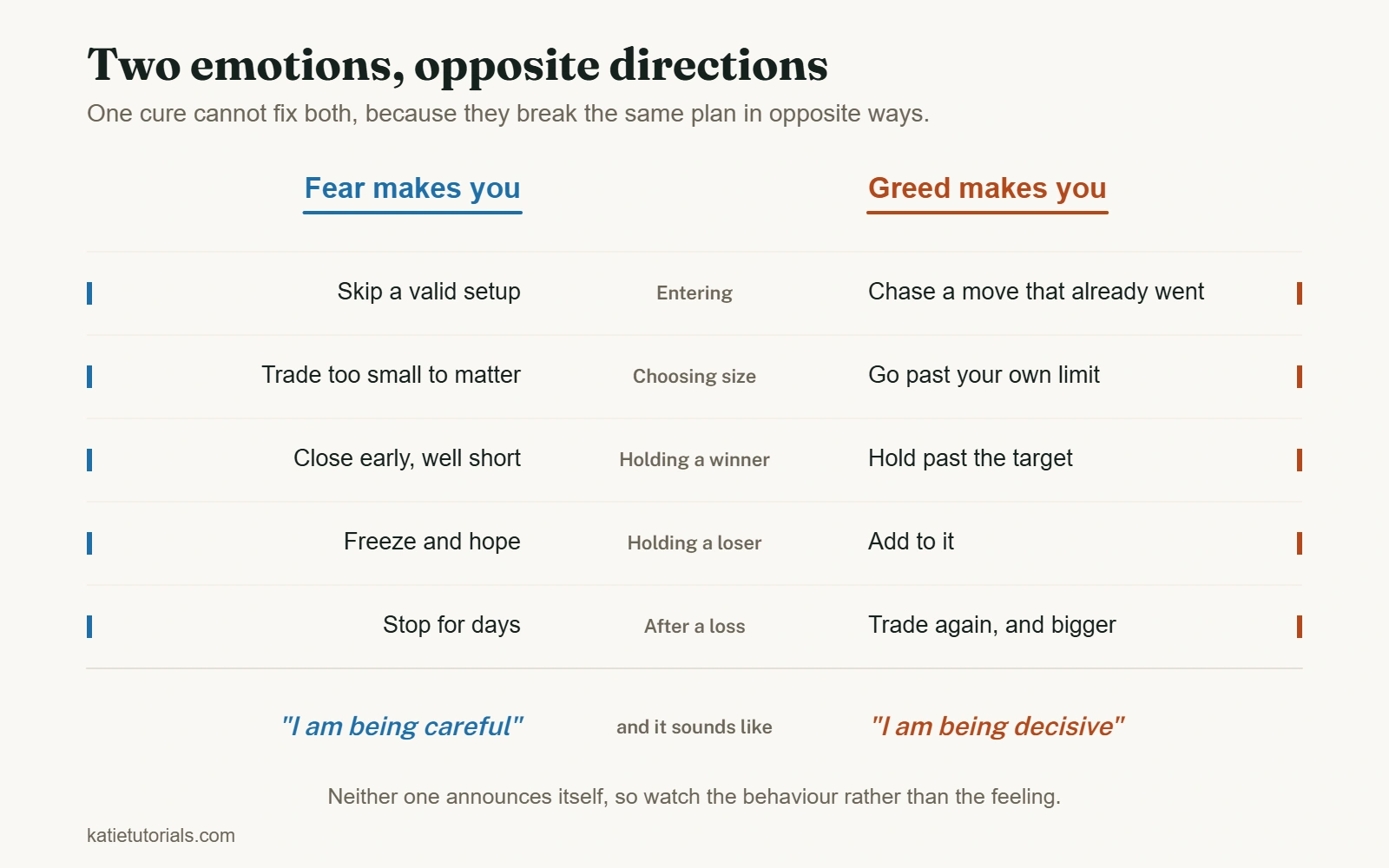
| At this moment | Fear makes you | Greed makes you |
|---|---|---|
| Entering | Skip a valid setup, or hesitate until the move has gone | Enter with no setup, or chase price that already moved |
| Choosing size | Trade too small for the result to matter | Go past your own limit because this one feels certain |
| Holding a winner | Close early for a fraction of the target | Hold past the target waiting for more |
| Holding a loser | Freeze and hope it comes back | Add to it so the average looks better |
| After a loss | Stop trading for days, including the good setups | Trade again immediately, and bigger |
| The story you tell yourself | “I am being careful” | “I am being decisive” |
Read the last row twice. Both of those sentences are things a sensible person says. Neither is available to you as evidence, because you will say them in exactly the situations where they are least true.
How to tell which one you are in
Since the feeling is not reliable, use the behaviour. These are observable, and you can check them in a few seconds without needing to be honest with yourself first.
| What you notice yourself doing | Which state | What to do about it |
|---|---|---|
| Checking the position every few seconds | Fear | Set a price alert and close the tab. The chart does not need you |
| Wanting to close a winner well before the target | Fear | Nothing. The target was chosen when you were calm and you were more reliable then |
| Reaching for a bigger size right after a red trade | Greed | Stop for the day. This is the expensive one |
| Entering without writing down why | Greed | Write the sentence first. If it comes out vague, there is no trade |
| Feeling certain | Greed | Halve the size. Certainty is a feeling, not information |
| Relief when a position closes, win or lose | Fear | The position was too big. That is a sizing problem, not a nerve problem |
That last one is the most useful line in this article. Relief is a measurement. If closing a trade makes you feel lighter, you were carrying more than you could think clearly while holding, and no amount of mental training fixes a size that is wrong.
What to do about fear
Make the position small enough to be boring
Fear at the screen is almost always a sizing problem in disguise. A position you can hold calmly through normal noise is the right size, and a position that makes you watch every tick is not, however good the setup looked. Cutting size feels like giving up on the trade. It is the opposite: it is what lets you actually hold it.
Let the decision you already made stand
Fear mostly attacks exits. The target you set before entering was chosen by a calmer, better informed version of you, and the version who wants to close early at 40% of target has less information, not more. If you keep overriding your own targets, that is a thing to log and count, not to argue with in the moment.
Separate caution from avoidance
Skipping a setup because the conditions are wrong is judgement. Skipping it because the last one lost is fear. They feel identical from inside. The only way to tell them apart afterwards is a written reason, which is the case for keeping a trading journal.
What to do about greed
Fix the size before the session, not during it
Greed does not usually change your strategy. It changes your size, and it does it one trade at a time so that no single step looks unreasonable. Decide the number before the market opens and treat it as settled, the way you treat the time you set your alarm for.
Treat certainty as a warning
The trades that go worst are rarely the ones you felt unsure about. They are the ones you were sure about, because certainty is what removes the checks. My own worst day started with a signal I had no doubt about at all.
Never size up to recover
Increasing size after a loss is the single most destructive habit in trading and it deserves its own treatment, which it has in how to stop revenge trading. The short version: the arithmetic of doubling after each loss turns five ordinary losing trades from a 5% hole into a 39% one.
The rule that covers both
Everything above reduces to one principle. Make the decisions when you are calm, and make them mechanical enough that the version of you at the screen cannot renegotiate them.
In practice that means four numbers written before the session starts:
- The size, worked out as a percentage rather than chosen by feel.
- The entry condition, in a sentence specific enough to be wrong.
- The exit, both the target and the level that ends the idea.
- The point at which you stop for the day, in money.
Notice that none of these is about emotion. You are not trying to feel differently, which is not something you can do on command. You are trying to reduce the number of decisions available to you at the moment when your judgement is worst. That is a design problem, and design problems are solvable.
When it stops being about discipline
Every article on this subject stops at “manage your emotions”. It is worth saying what none of them say, which is that for some people this is not an emotional control problem at all.
Research published in Frontiers in Psychiatry in 2021 by Hakansson, Fernandez-Aranda and Jimenez-Murcia reports that around 8% of financial market investors may meet the criteria for problem gambling in relation to their trading, and describes rapid trading as a recognised route to over-indebtedness and mental health difficulty.
The honest test is not how you feel while trading. It is what the trading is doing to the rest of your life:
- You are trading with money needed for rent, bills or debt.
- You hide the size of your losses from people close to you.
- You have decided to stop more than once and did not.
- It is affecting your sleep, your work or your relationships.
If several of those are true, the four numbers above will not hold, because they are not designed for this. It is the same territory as gambling, it responds to the same kinds of support, and speaking to a doctor or a gambling support service is a sensible first step rather than a dramatic one.
Common questions
How do I remove emotion from trading completely?
You do not, and the traders who claim to have done it are describing good systems rather than an absence of feeling. The realistic aim is to make the emotional moment irrelevant by having already decided, not to stop having the moment. Full automation removes the decisions, but it moves the emotion rather than deleting it, into when to switch the system off.
What did Warren Buffett say about fear and greed?
His well known line is to “be fearful when others are greedy and greedy when others are fearful” (Warren Buffett). It is worth being clear about what it means, because it gets quoted at the wrong problem. He is describing contrarian positioning against market wide sentiment over long horizons. He is not saying anything about managing your own reaction to a losing trade on a Tuesday afternoon, which is what this article is about. The two get conflated constantly.
Why do 95% of traders lose?
The specific figure is folklore, though the documented numbers are not far off it and are covered properly in why you keep losing money. As for emotion’s share of the blame: it is rarely the direct cause. Emotion changes the size and the timing, and it is the size and the timing that do the damage.
Does a demo account help with this?
For learning the platform, yes. For this, almost not at all. Fear and greed are responses to money being at risk, and on a demo account nothing is. A very small live account teaches you more about your own behaviour in a week than a large demo account will in a year.
The short version
Two states, opposite directions. Fear cuts winners, skips setups and freezes on losers. Greed oversizes, chases and adds to losers. Neither announces itself, so watch the behaviour rather than the feeling.
Then decide the four numbers while you are calm, and build it so that the person at the screen has nothing left to decide.