
The honest answer is not a number, it is a ratio. Your account has to be large enough that what it costs to place a trade is small next to the amount you are risking on that trade. Everything else follows from that one relationship.
Most answers to this question are either a broker’s minimum deposit, which is marketing, or a figure someone made up. This page works it out.
The ratio that actually decides it
Two numbers set your floor. The first is your risk per trade, which for a beginner is 1% of the account. The second is what a round trip costs you: the spread, plus commission, plus any financing.
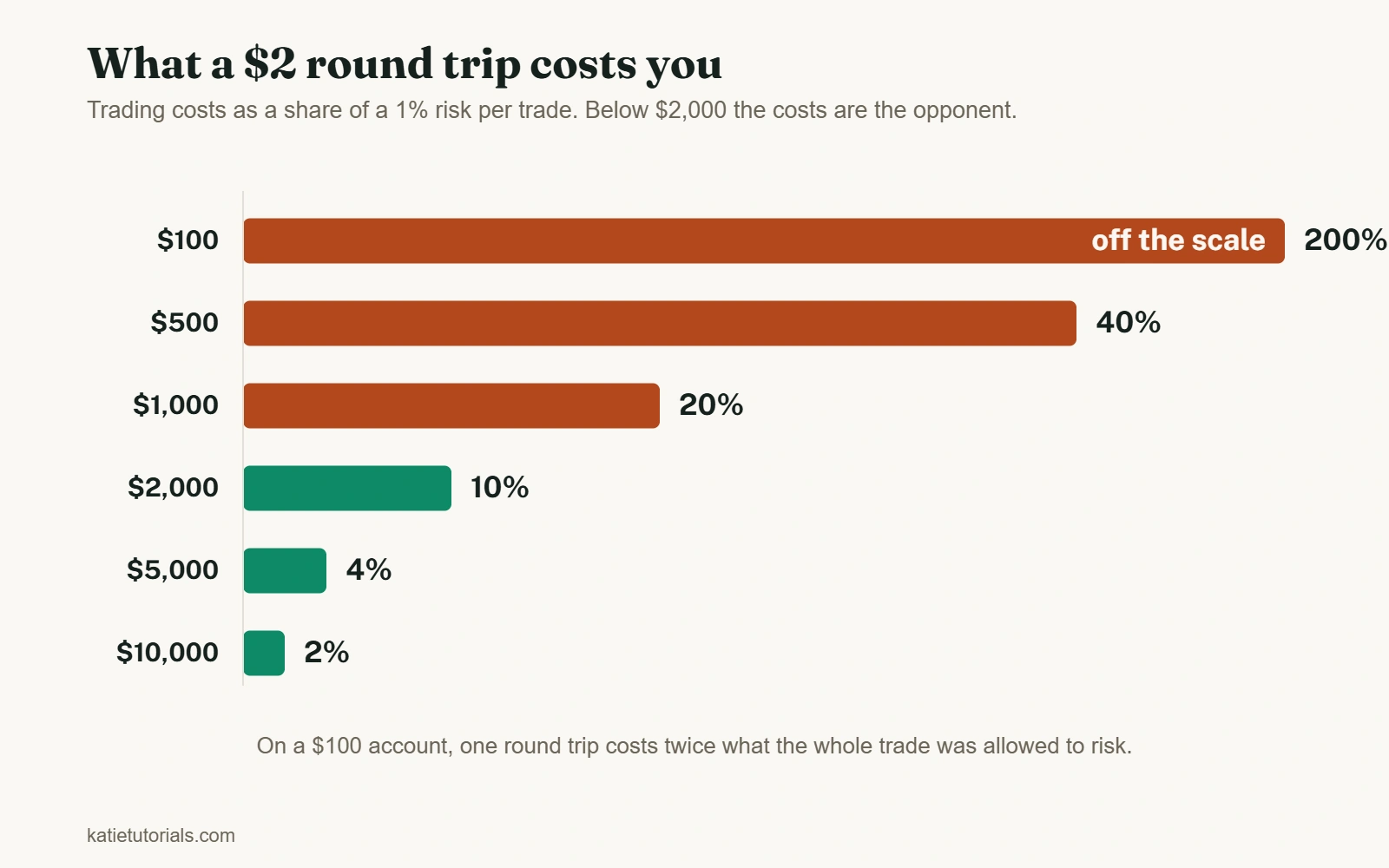
Say a round trip costs $2, which is modest. Here is what that means at different account sizes:
| Account | 1% risk per trade | $2 round trip is | What that means |
|---|---|---|---|
| $100 | $1 | 200% of your risk | The costs are larger than the trade. Not possible |
| $500 | $5 | 40% | You need to beat the market by 40% just to break even |
| $1,000 | $10 | 20% | Very hard. Every fifth win pays the broker |
| $2,000 | $20 | 10% | The first size that is arguably workable |
| $5,000 | $50 | 4% | Costs are a normal drag rather than the main opponent |
| $10,000 | $100 | 2% | Comfortable |
That table is the whole article. Below roughly $2,000 you are not primarily trading against the market, you are trading against your own transaction costs, and they win because they are charged with certainty while your profit is a probability.
Two caveats in your favour. If your broker charges nothing and the spread is tight, the cost column shrinks and so does the floor. And if you risk 2% rather than 1%, the ratios halve, though that is buying room by taking more risk rather than by having more money.
Can you start with $100?
You can open an account. You cannot run a strategy.
At 1% risk that is one dollar per trade, and there is no instrument where one dollar of risk survives contact with a spread. To make it work you would have to risk 10% or 20% per trade, at which point four or five ordinary losses take most of the account, and ordinary losses are not rare.
What $100 is genuinely good for is learning the mechanics with real money involved, which teaches you more about your own behaviour than any demo account. Treat it as tuition rather than capital, expect to lose it, and do not scale the results up in your head.
Is $500 enough? Is $1,000?
They are enough to trade, and not enough for the results to mean much. At $500 you are handing the broker 40% of your risk on every round trip, so a strategy that would be profitable at a larger size can still lose money at that one. This is the trap in “start small and grow it”: the small version is harder than the large one, not easier.
If $500 is what you have, the sensible use of it is to run your actual strategy at your actual risk percentage for fifty trades and judge the decisions rather than the balance, using the method in how to know if your strategy works.
The American $25,000 rule has just been removed
Anyone researching this in the past twenty years will have been told that day trading in the United States requires $25,000, under the pattern day trader rule. That is no longer the position, and most pages still say it is.
FINRA proposed replacing the rule in December 2025, and the Securities and Exchange Commission approved the change on 14 April 2026. The approval eliminates the pattern day trader designation and the $25,000 minimum equity requirement, replacing them with intraday margin requirements that apply to margin accounts generally.
Two practical notes. There is a transition period in which firms may continue operating under the previous arrangements, so your broker may still apply the old threshold for now, and you should check with them rather than with an article. And the older $2,000 minimum for opening a margin account at all is a separate requirement.
The rule change also does not alter anything in the table above. Removing a regulatory floor does not remove the arithmetic one.
Can you make $1,000 a day?
This question is usually asked about income, so let us answer it as arithmetic rather than as encouragement.
A thousand dollars a day across roughly twenty trading days is $20,000 a month. Work backwards from the account size that would need:
| Monthly return | On $10,000 | On $100,000 | On $500,000 |
|---|---|---|---|
| 2% | $200 | $2,000 | $10,000 |
| 5% | $500 | $5,000 | $25,000 |
| 10% | $1,000 | $10,000 | $50,000 |
Read the bottom row carefully. A sustained 10% a month is exceptional, well beyond what most professional funds produce over any long period, and even at that rate $20,000 a month requires a $200,000 account. At a still very good 3% a month it requires closer to $670,000.
The table is there to give you the scale, not a target. The useful conclusion is that anyone presenting $1,000 a day as a realistic goal for a small account is describing a return rate that does not exist reliably, and is usually selling the course that explains it.
The money you should not use
Separate from how much, there is the question of which money. This part is not complicated.
- Money needed for rent, bills or food within the next year.
- Money borrowed, including credit cards, overdrafts and loans from family.
- An emergency fund, which is doing a more important job where it is.
- Money you would have to explain losing to someone who did not agree to the risk.
The reason is not moral, it is mechanical. Money you cannot afford to lose changes how you trade, and it changes it in the direction of every mistake on this site. You hold losers because you cannot accept the loss, and you cut winners because you need the certainty. The size of the account matters less than whether you can be indifferent to any single trade on it.
So what is the number?
Combining the arithmetic with the behaviour:
| If you have | The honest use of it |
|---|---|
| Under $500 | Tuition. Learn the mechanics with real money, expect to lose it |
| $500 to $2,000 | A real test of your decisions, where the balance will still be dominated by costs |
| $2,000 to $10,000 | A working account where the results start to reflect the strategy |
| Above $10,000 | Costs are a minor drag. The constraint is now entirely you |
And the far more important number, at any size: the percentage of the account you risk per trade, covered in managing risk in trading. A disciplined $2,000 account outlives an undisciplined $50,000 one, and this is not a figure of speech.
Common questions
Is $10 enough to start trading?
No. Some brokers will accept it, which is a marketing decision rather than a statement about viability. At $10 there is no risk per trade small enough to be meaningful and no cost structure that leaves anything over.
Should I add money to a losing account?
Not while it is losing. Adding funds during a drawdown is the same impulse as increasing size after a loss, wearing a more respectable coat. Establish that the strategy has positive expectancy first, then fund it. Adding money to an approach that loses money simply buys more losses.
Is it better to start small and grow, or wait and save more?
Start small for the learning, but understand that the small account is running a harder version of the game because of the cost ratio. The common mistake is to conclude from a small losing account that the strategy does not work, when the honest conclusion is that it was never given a fair test.
The short version
Your floor is set by costs, not by the broker’s minimum. Below about $2,000 the round trip eats too much of a 1% risk for the results to mean anything, and below $500 you are paying for tuition rather than trading.
The American $25,000 day trading threshold was removed in April 2026, which changes the regulation and none of the arithmetic.