
The exit is not something you work out while the trade is running. It is decided before you enter, at the same time as everything else, and then carried out. Almost every exit problem is really a planning problem that has been postponed until the worst possible moment.
Getting the direction right is the part people practise. Getting out is the part that decides what the correct direction was worth.
Being right and losing anyway
I found what looked like a perfect entry with RSI and Vortex, and then rushed the part that mattered just as much. I picked a shorter duration than my own analysis called for.
The price moved exactly as I had predicted. My position had already closed during a short pullback before it got there.
Being right about direction is worth nothing if the exit is wrong, and I had given the exit about two seconds of thought.
That is the shape of most exit mistakes. Not a bad read of the market, a good read wasted. The analysis got twenty minutes and the exit got two seconds, and the account only ever pays out on the second one.
Every trade needs three exits, not one
Most people plan one exit, the profit target, and treat everything else as improvisation. A complete plan has three, and all three are written before you click.
| The exit | What it is | What decides it |
|---|---|---|
| The target | Where you take the profit | Structure on the chart. The next level, the prior high, a measured move |
| The invalidation | The point where the idea is no longer true | The chart again. Not your account, and not a round number |
| The time exit | When you leave because nothing happened | The thesis. If the move was supposed to happen on the open and it is lunchtime, the reason to be there has gone |
The third one is the one almost nobody writes down, and it is where a surprising amount of money goes. A trade that is neither winning nor losing is still costing you: spread, financing, and the attention you are not giving to the next setup. “It has not hit my stop yet” is not a reason to stay in something that has stopped doing what you expected.
What cutting winners early actually costs
Taking profit early feels prudent. A booked gain is real, and a target is only a hope. That feeling is doing something specific to your numbers, and it is worth seeing it written down.
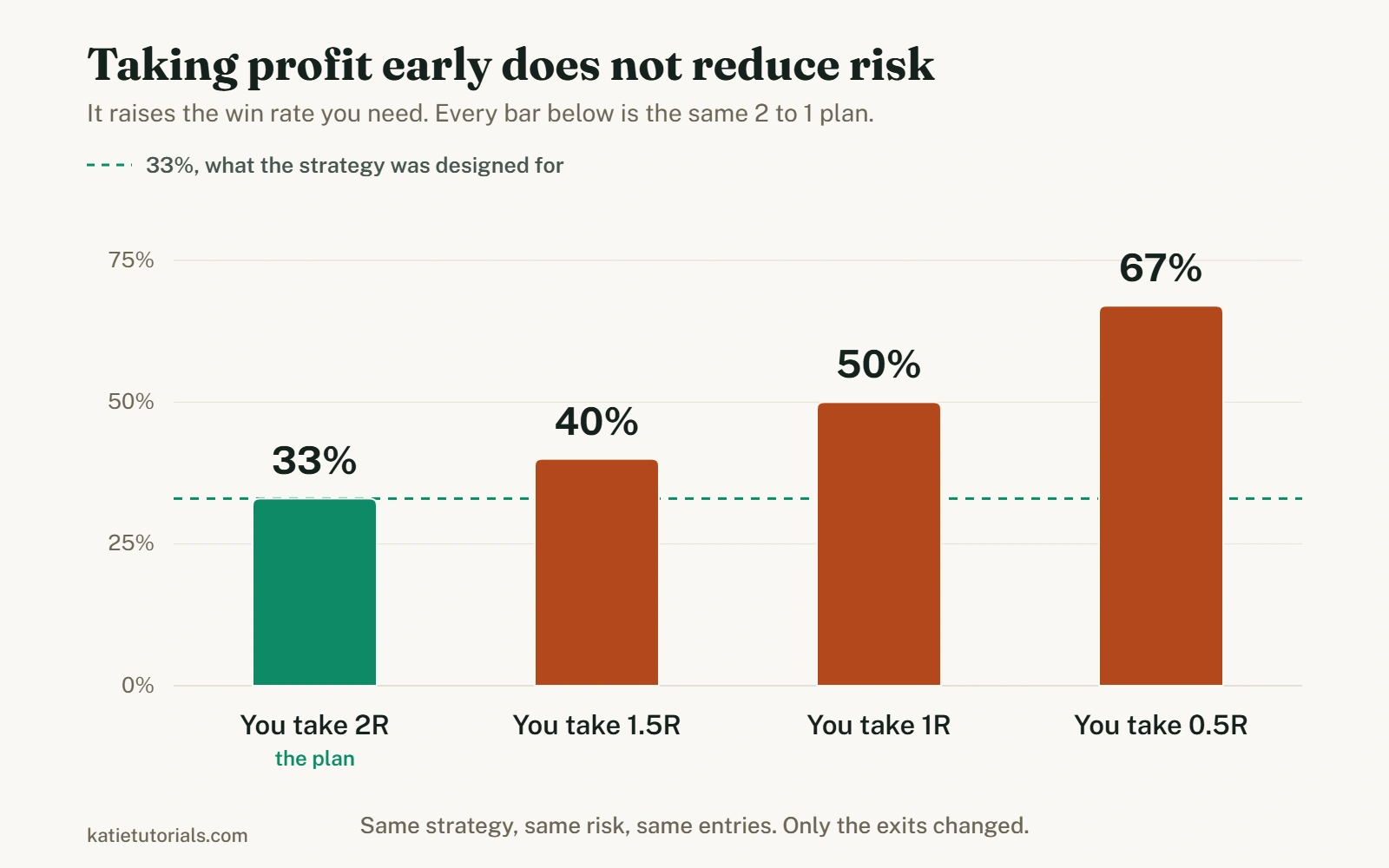
Your break even win rate is set by the ratio you actually achieve, not the one you planned. So if you plan a 2 to 1 trade and habitually take half of it, you have not reduced your risk. You have raised the bar you need to clear.
| You planned | You actually take | Win rate you now need to break even |
|---|---|---|
| 2 × your risk | 2 × risk | 33% |
| 2 × your risk | 1.5 × risk | 40% |
| 2 × your risk | 1 × risk | 50% |
| 2 × your risk | 0.5 × risk | 67% |
Read the bottom row. A trader who plans 2R and habitually banks a quarter of it needs to be right two times in three, on a strategy that was designed to work being right one time in three. Nothing about the strategy changed. Only the exits did.
The maths behind that single division is covered in managing risk in trading.
Why you keep getting out too early
This has been measured. Terrance Odean studied 10,000 brokerage accounts and found investors realised their gains at a rate of 14.8% and their losses at 9.8%, meaning a winner was roughly 1.5 times more likely to be sold than a loser. Over the following year, the winners they sold outperformed the losers they kept by 3.4 percentage points.
So the instinct is not merely emotional. It is backwards, and it is expensive, and it is close to universal. Knowing that does not switch it off, but it does tell you what to build against.
Three things usually drive it:
- The last trade. After a loss, the next winner gets closed early to make the day green. The size of the win is set by your previous trade rather than by this one.
- Watching. The more closely you watch a position, the earlier you will close it. Every tick against you is a small argument, and eventually you agree.
- The position is too big. If holding through normal noise is uncomfortable, you will find a reason to get out. That is a sizing problem wearing an exit costume.
Which of the three it is matters, because they have different fixes, and there is more on telling them apart in controlling your emotions when trading.
Partial exits, honestly
Taking some off at the first target and leaving the rest is the usual compromise, and it is a reasonable one, but it is sold as a free lunch and it is not.
What it genuinely does is make the position easier to hold, which is worth a great deal if the alternative is closing all of it early. What it also does is cap your best trades, which are the ones that pay for everything else. A strategy where the top few results carry the year is badly served by a rule that halves them.
Two conditions make partials sensible: you decided on them before entering, and you have enough trades logged to know whether your winners usually run past the first target. Deciding to take partials at the moment the trade is up is not a strategy, it is the early exit with better branding.
When it is right to move an exit
Not all adjustment is weakness. The test is always the same: what changed, the chart or your feelings?
| The move | What it usually means | Verdict |
|---|---|---|
| Widening the stop because price is close to it | You are converting a known loss into an unknown one | Never |
| Trailing the stop up as the trade moves your way | Protecting a real gain by a written rule | Fine, if the rule was written first |
| Closing early because the setup broke | The chart withdrew the reason you entered | Correct, and it is not an early exit at all |
| Closing early because it is taking a long time | Boredom | That is a time exit, so write it into the plan and stop improvising it |
| Extending the target because it is going well | Greed renaming itself confidence | Almost never. Take the trade you planned |
The third row deserves emphasis. Exiting because the reason for the trade disappeared is not undisciplined, it is the whole point of having a reason. What makes an exit early is that nothing changed except your nerve.
How to tell if exits are your problem
You do not have to guess. If you keep a record, the answer is two columns wide.
- Put your planned exit and your actual exit side by side for the last twenty trades.
- Count how many times they match.
- For the ones that do not, write which direction you went: out early, or held past the plan.
If most of the mismatches are early exits on winners, the problem is nerve and size, not analysis. If they are late exits on losers, that is the opposite problem and more urgent. If the planned column is often empty, there was never a plan to miss, which is the easiest of the three to fix and the most common.
The template in how to keep a trading journal has both columns in it for exactly this reason.
Common questions
How do I know when to close a trade?
When one of your three exits is reached: the target, the invalidation level, or the time limit. If you are asking the question in the middle of a trade and none of those has been hit, the honest answer is that you did not finish planning it and are finishing now, under pressure, with money on the line.
How long should you stay in a trade?
As long as the reason you entered is still true. That is a shorter time than most people hold losers and a longer time than most people hold winners. If your thesis had a timeframe attached, which it should, that timeframe is your answer.
What happens if I never close a trade?
Depends on what you hold. A share position can be held indefinitely and simply rises and falls. A leveraged position accrues financing costs daily and can be closed for you if the margin runs out, and a dated product closes itself at expiry whether you were ready or not. The common thread is that not deciding is still a decision, and it is made by someone other than you.
Should I use a fixed target or a trailing stop?
Fixed targets suit strategies with a clear structural level to aim at, and they are easier to test because the plan is unambiguous. Trailing suits trending conditions where the move can run much further than any level you could have named in advance. The wrong answer is switching between them mid trade, which is how you get the worst of both.
The short version
Write three exits before you enter: where you take the profit, where the idea is dead, and when you leave because nothing happened. Then carry them out.
Cutting winners early does not lower your risk. It raises the win rate you need, quietly, until a strategy that worked on paper stops working in the account. I have paid for that lesson, and the entry was not the part that was wrong.